
by Matt Mitchell, PT, DPT
Therapy at The Shea Center is always goal driven. Our physical, occupational, and speech therapy professionals carefully select appropriate functional goals. We also regularly measure progress over time using a variety of methods. We take a collaborative approach to goal setting and always include our patients and their families in creating meaningful functional goals. Our methods are often covered by the guise of play when working with kids; however, each intervention is carefully chosen to progress our clients towards the therapist’s functional goals.
Physical Therapy
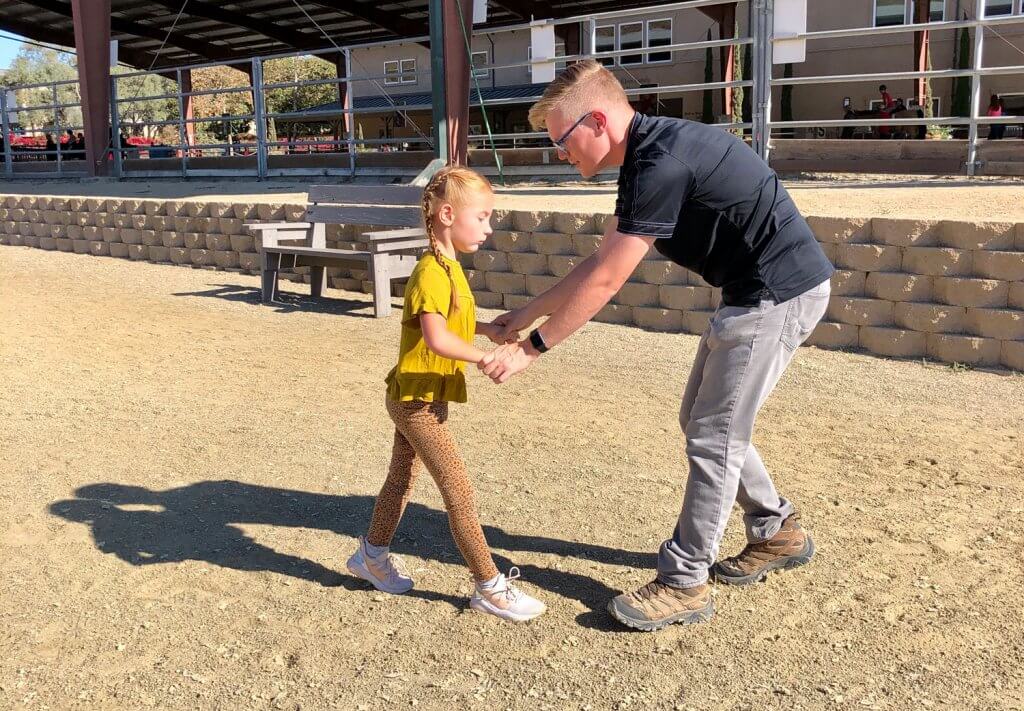
“Physical therapists (PTs) are movement experts who improve quality of life through prescribed exercise, hands-on care, and patient education.” American Physical Therapy Association PTs choose specific tools such as weights, toys, games, stairs, horses, obstacle courses, balls, etc. to work towards their movement goals. In pediatric physical therapy, most activities used to meet our goals are fun! At The Shea Center, we specialize in the purposeful manipulation of equine movement in our treatment sessions. The horse is a fantastic tool that our PTs use to work on balance, protective responses, body-awareness, motor planning, and so much more. When clients are on the horse with treatment directed by a PT, they are not working on riding skills, but rather using the movement of the horse to meet functional movement related goals. Here are some common PT goals:
- Client will negotiate a multi-step obstacle course (e.g., balance beam, ramp, curb, stairs, climbing equipment) for five repetitions with moderate assistance.
- Client will maintain static standing balance with feet shoulder-width apart and supervision to improve safety in the standing position.
- Client will squat to pick object off ground and return to upright with contact guard assistance and no upper extremity support to improve gross motor skills.
- Client will exhibit posterior protective reactions to improve safety in the sitting position.
Occupational Therapy
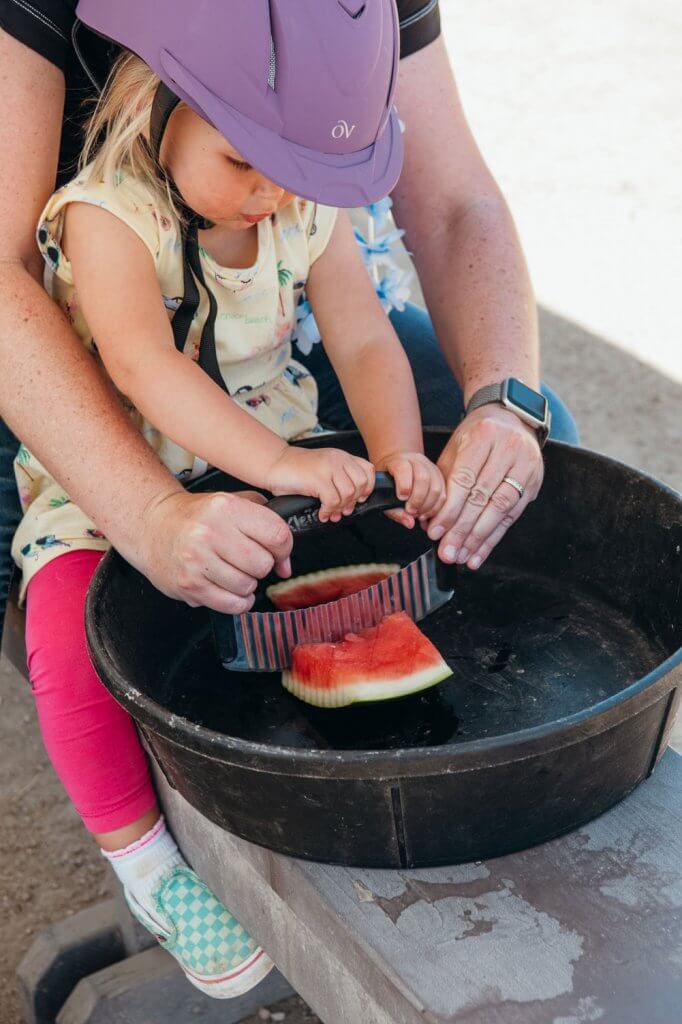
“A child’s life is made up of “occupations,” or daily activities. These occupations include playing, learning, and socializing. Occupational therapy practitioners (OTs) work with children and their families to help them succeed in these activities throughout the day.” American Occupational Therapy Association OTs at The Shea Center have many tools they use to meet client goals relating to activities of daily living such as dressing, grooming, and eating. In fact, you will often find an OT wearing an apron full of toys and games! The use of equine movement is a great way to build strength, balance, coordination, and motor planning as well as for sensory input and attention to achieve functional goals. The movement and sensory input received while on the horse allows for tactile, proprioception, and vestibular input to help clients form adaptive responses and develop organization of behavior. Here are some common OT goals:
- Client will improve fine motor and bilateral coordination as shown by buttoning five large buttons with minimal assistance in three out of four trials.
- Client will increase fine motor strength to be able to open simple food packages with minimal assistance in three out of four trials.
- Client will improve fine motor and motor planning skills to be able to use a fork and spoon to eat one-half of a meal with minimal spillage in three out of four trials.
- Client will demonstrate improved organization of behavior by being able to process/organize/form an adaptive response in order to increase participation during all activities of daily living tasks including tooth brushing for ten seconds in three out of four trials.
Speech and Language Therapy
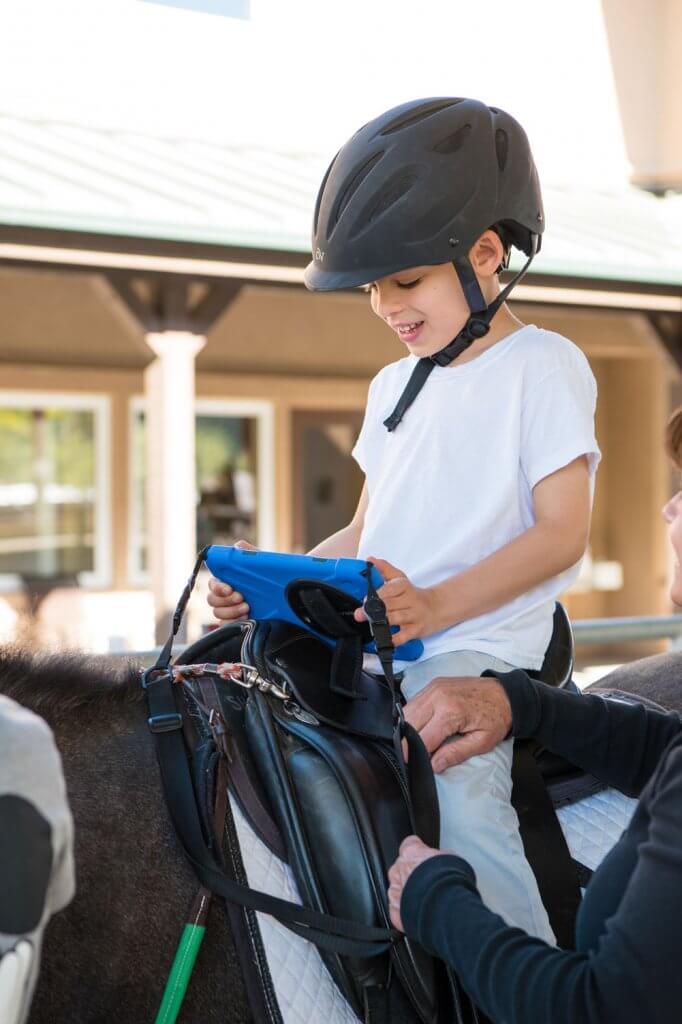
“Speech-language pathologists (SLPs) are experts in communication. SLPs work with people of all ages, from babies to adults. SLPs treat many types of communication and swallowing problems.” American Speech-Language-Hearing Association SLPs at The Shea Center utilize equine movement to stimulate arousal, promote breath support, and motivate their clients. After participating in mounted activities, clients then are more prepared to participate in speech tasks in the clinic and in their daily life. Here are some common speech goals:
- Client will produce irregular past tense verbs to describe a picture given a verbal elicitation prompt in three out of five opportunities.
- Client will use the pronouns “we, they, us, them” in four out of five opportunities over two consecutive sessions given a verbal prompt.
- Client will express single words to comment or request given no more than two prompts four of eight trials.
- Client will lift his tongue to the alveolar ridge given tactile cuing in three out of five opportunities over two consecutive sessions.