
by Matt Mitchell, PT, DPT
The J. F. Shea Therapeutic Riding Center is focused on high-quality, client-centered care. We constantly seek to improve the lives of people with disabilities through therapeutic, horse-related programs. We so strongly believe in this ideal that we conducted our own scientific study to evaluate how our clients improved with physical therapy (PT) using hippotherapy. Our therapists put on their scientist hats to ask the question: “What tool can we use to measure the effects of treatments using hippotherapy, and are we making statistically significant improvements in our clients’ lives?” The answer became clear through data collection using the Pediatric Evaluation of Disability Inventory – Computer Adaptive Test (PEDI-CAT). The PEDI-CAT data showed clients exhibited statistically significant improvements across four areas of functioning (i.e., mobility, daily activities, social skills, independence) for a group of 35 children receiving PT using hippotherapy at The Shea Center across six months. This study was presented at three national conferences, as well as one international conference, adding to the growing body of scientific evidence supporting the use of equine movement in physical therapy treatments.
The Study Design
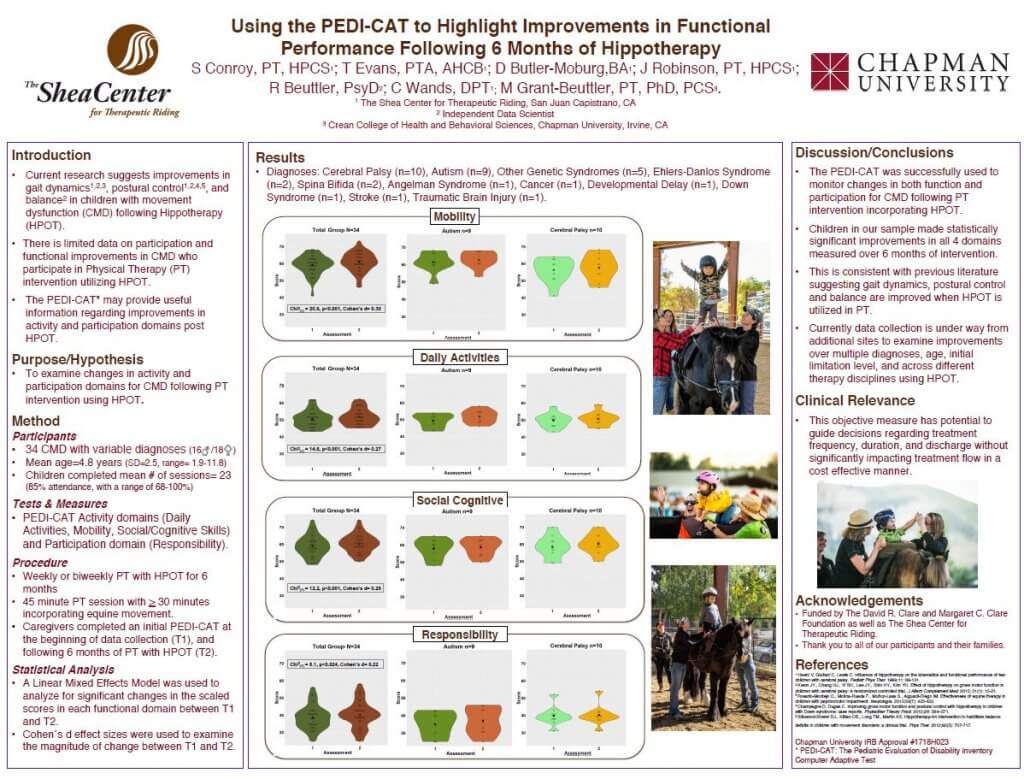
Data in this study came from 35 children with varying diagnoses, including autism, cerebral palsy, Down syndrome, and other movement disorders. Children’s average age was 4.8 years. Participants completed PT treatments, using hippotherapy, over a six-month period. Therapy sessions were 45 minutes long, with at least 30 minutes spent using equine movement as a treatment tool. Participants’ parents or caregivers completed the PEDI-CAT survey at the initial treatment session and then again six months later. This allowed us to compare outcomes on PEDI-CAT between the two time points for each child. On average, participants made statistically significant improvements over the six-month treatment period correlated with using hippotherapy as a treatment tool for this sample population.
How the PEDI-CAT Can Guide Treatment Decisions
One example of how the PEDI-CAT results helped guide treatment decisions was with an eight-year-old child who was non-verbal, had some behavioral challenges, and was unable to follow directions. On her first assessment she scored below the fifth percentile in all areas of the PEDI-CAT. Due to her inability to follow directions, it was difficult to accurately assess her abilities with measures that require client participation with the test. For example, her therapist could not ask her to demonstrate a skill, such as standing on one foot, to assess balance because she could not understand the directions to complete the task. There was also variability between the skills she demonstrated spontaneously at home and those she displayed during therapy sessions. On her second PEDI-CAT assessment she showed improvement in her mobility skills from below the fifth percentile to between the fifth and twenty-fifth percentile. This corresponded with her mom’s reports of improved gross motor skills at home. She was no longer falling when she played in the yard and now could climb stairs on her own at home. This child was kept longer in physical therapy since she was demonstrating improvements in gross motor skills corresponding to her starting physical therapy utilizing equine movement.
The Outcome Measurement Tool

The PEDI-CAT is a parent-report survey that is administered via iPad. It can be completed by parents of children ages 0-20. This unique tool assesses multiple areas of need by asking questions about how difficult it is for the client to perform tasks such as “Puts on a T-shirt, inserts a straw into a juice box, stands for a few minutes, writes a legible three item list, gets ready in the morning on time, etc.” These questions were of interest to our Shea Center therapists as they span what is called the International Classification of Functioning (ICF) Model. The ICF model was designed by the World Health Organization to shift the focus of medicine and therapies away from the negative connotations of disability and instead to bring light to the positive attributes of functioning. It also helps clinicians to consider the whole client, incorporating important aspects of life domains like daily living, environment, and participation in roles they perform in society. The PEDI-CAT provided our therapists with information about functional activities and participation level abilities that are often difficult to assess objectively. The survey takes less than 15 minutes for a parent or caregiver to complete, and it can be completed while the client participates in therapy, without taking away therapists’ or clients’ time and attention. The test results are computed immediately and can be presented visually to track changes over time comparing different time points. This is important as our therapists frequently use the PEDI-CAT reports to facilitate conversation with families about their child’s progress and areas of need. This can be instrumental in helping to foster greater treatment personalization.
Why it Matters
What’s important about the research we do is how we can use what we learn to help improve our clients’ lives. One example of our research in action was a young boy, about five years old, who was going to start kindergarten in the fall. He had been given the PEDI-CAT every six months for the past year. On his first two tests (given six months apart) he showed improvements on his mobility skills, social/cognitive skills, daily activities and responsibility skills. On his third test, given six months later, he continued to show improvement in all areas, except he had a decline in responsibility scores. When his therapist discussed this with his mom she voiced concerns, similar to what the test result had shown. She stated he has spent so much time working with therapists and doctors in his first five years, due to his medical issues, he had missed out on learning how to behave in a group of children as his older brothers had done. She was concerned that when he started kindergarten in the fall he would struggle with things such as taking turns, listening and following directions, and other skills kids develop in early group activities with peers. So it was decided that this was the area he needed to focus on the summer before school started. He was discharged from physical therapy and used that time to take part in an equine summer camp which focused on teaching the skills he needed to succeed in kindergarten.
Our therapists learned five valuable lessons from this study:
- The PEDI-CAT is an effective tool and is easy to administer to track changes in function and participation levels for our clients at The Shea Center.
- A group of 35 clients made, on average, statistically significant improvements over six months of treatment using hippotherapy.
- More research is needed to better understand how the effects of hippotherapy specifically contributed to the improvements observed in this study.
- The PEDI-CAT provides our therapists with valuable data to assist in clinical decision making, such as whether to increase or decrease treatment frequency, mode, or focus.
- Clinical research can be tedious, but it also shines an invaluable light for the future of our industry, growing an evidence base to draw on for implementing practices we are confident work.
The Shea Center serves over 1,250 clients each year. The majority (77%) of these clients are under the age of 18 (that’s 960 children!). Our client families often tell us about the inspiring improvements they observe as their child rides a Shea horse. This study presents our clients’ stories through numbers and visual statistics to support the growing body of science behind hippotherapy. The PEDI-CAT is a useful tool for tracking changes over time in functional and participation level domains by producing quantifiable data that can be scientifically analyzed. By going through this process, our therapy team has learned to better personalize their therapies and to continue collecting valuable data to track changes over time with the regular implementation of the PEDI-CAT.