
Did you know that horses have around 205 bones and 700 muscles?
A unique fact about horses is that their eyes are set on each side of their head, allowing them to see about 350 degrees. Due to this anatomical distinction, a horse’s depth perception is less than that of humans. Because they are prey animals, they are often alert to moving objects in the distance. They have small blind spots directly in front of them, below them, and behind them. Horses mainly have monocular vision, independently seeing both sides of their body. They also have a small percentage of binocular vision, using both eyes to see the environment ahead of them (Young, 2024).
It is interesting to note that because horses’ eyes are set on the sides of their head, they see different objects through each eye on the right and left sides (Iowa State University). Horses get worked in both directions in an arena, allowing them to see the environment with both eyes.
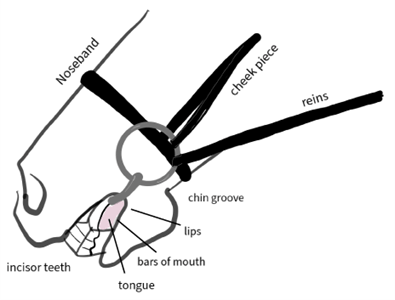
Photo credit – Iowa State University
On average, horses have between 36 and 44 teeth. The teeth in front of their mouth are called incisors and are used to cut and grasp their food. The teeth on the sides of their mouth are used to chew and grind the food. Between the two sets of teeth, there is a space where no teeth grow. This space area is called the bar area, where the bit of a bridle sits when a horse is exercised.
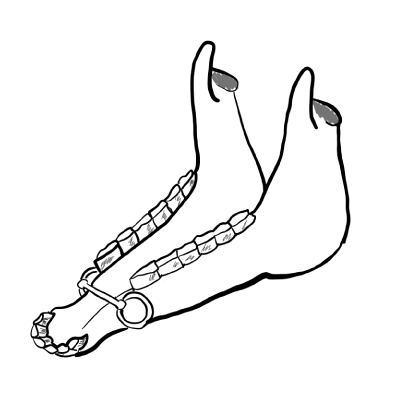
Photo credit – Iowa State University
Iowa State University. (n.d.). Vision in the equine. Equine Science. https://www.extension.iastate.edu/equine/vision-equine
Young, A. (2024). 10 things you might not know about equine ophthalmology. Horse Report / School of Veterinary Medicine UC Davis. https://cehhorsereport.vetmed.ucdavis.edu/news/10-things-you-might-not-know-about-equine-ophthalmology#:~:text=Horses’ %20eyes%20are%20located%20on,field%20of%2055%2D80%20degrees
Photo credit – Iowa State University
Our horses change lives every day. Learn more about our herd or become a horse sponsor by clicking here!