
by Randi Shannahan, PT, DPT
The power of hippotherapy is most deeply understood by feeling it first-hand. The term hippotherapy refers to the purposeful manipulation of equine movement by occupational, physical and speech therapists as a treatment strategy to promote functional outcomes.
Why We Do It
Our therapists developed what we call a “ride-along” as an experiential educational tool to showcase the effectiveness of equine movement in therapy to the healthcare community. Initially designed to demonstrate how the rhythmic motion of a horse can benefit patients, ride-alongs quickly evolved into something far more special! Today, they also serve as a training tool for students, adaptive riding instructors and new staff members. They are also used as an interactive tool for volunteers, donors, board members, and horse sponsors to strengthen their understanding and connection to The Shea Center.
The student, volunteer, parent, referring doctor or therapist, etc, will sit on the horse as if they were a client or patient while a member of our therapy team communicates what is transpiring between the horse and human. At the core, ride-alongs demonstrate an understanding of how the equine pelvis moves in three-dimensional planes, mirroring the movement of the human pelvis during walking.
What it Accomplishes
Ride-alongs demonstrate an understanding of how the equine pelvis moves in three-dimensional planes, mirroring the movement of the human pelvis during walking.
This synchronized motion creates a unique opportunity for therapeutic intervention. The horse’s walk activates the same muscles and mobilizes the same joints as typical walking in a human, so that the client can experience fluid and organized movement with natural variability—the way walking should be! No other mechanical device or mechanism in therapy or medicine can replicate this phenomenon.
Consider this: as each hoof of the horse hits the ground, a “ground reaction force” is generated that produces a neuromotor input sent up the chain to the human astride. An average-sized horse takes approximately 100 steps per minute, translating to 3000 neuromotor inputs during a 30-minute session. This abundance of inputs provides a corresponding number of repetitions to activate muscles, train balance reactions, improve postural control and develop motor learning. Just think of how impactful 3000 repetitions of any exercise could be, especially in such a short and concentrated time frame!
Ride-alongs help participants to better understand how our clients with sensory impairments may benefit from equine movement.
A ride-along also illustrates how the sensory systems are stimulated, revealing the profound benefits for individuals with sensory processing difficulties, such as those with Autism Spectrum Disorder, Visual Impairment and Deafness/Hard of hearing. Through visual flow, proprioception, vestibular input, and tactile experiences, the equine movement provides a holistic sensory experience that can aid in regulating and organizing sensory inputs. Essentially, this helps the client determine “how much” of each sensory input to “tune into” at any point in time.
Participants are able to challenge themselves to try exercises and positions our clients perform regularly during treatment sessions.
Whether sitting forward, backward, sideways, or in developmental positions like hand-and-knees, each posture offers unique benefits for physical, sensory and cognitive development. In addition, we can engage our ride-along participant in the same activities typically seen in a therapy session, like playing catch, reading a book, completing fine motor tasks, or using strength training tools like weights and resistance bands.
A ride-along represents a unique and powerful approach to describe the multitude of benefits from therapy services using hippotherapy. We love being able to share the wonders and joys of our favorite therapeutic intervention!
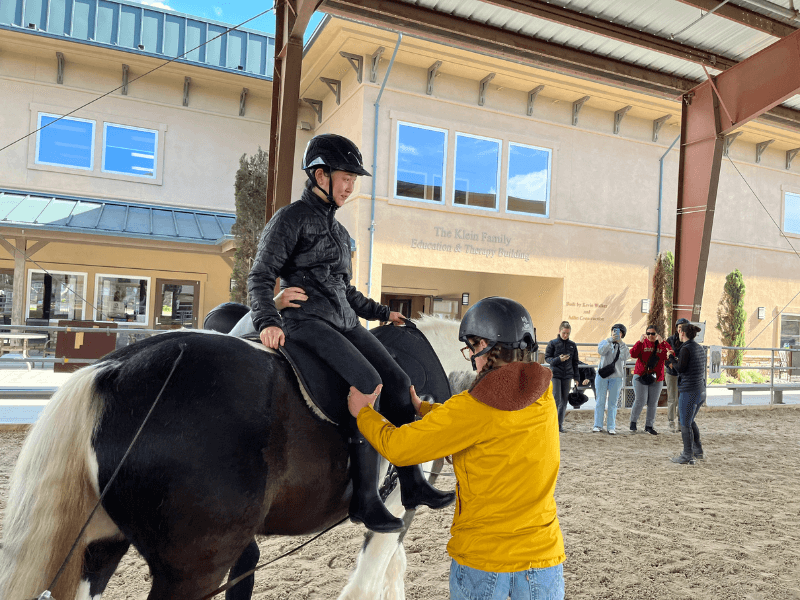
Ride-along with students from Chapman University’s Doctor of Physical Therapy program.
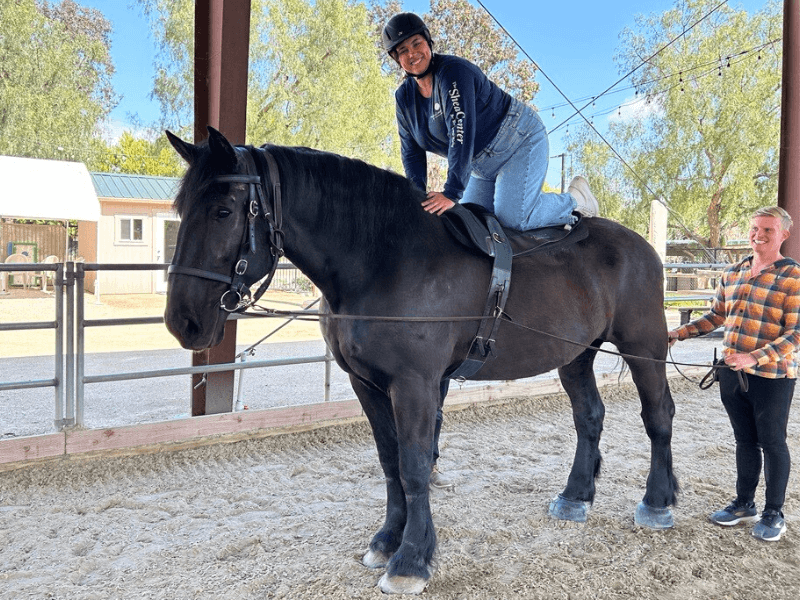
Staff members experiencing a ride-along on Dante, our therapy horse.