by Matt Mitchell, PT, DPT
Come to The Shea Center for 30 minutes and you are bound to see someone sitting on a horse backwards, sideways, or even standing on horseback! Have you ever wondered why our clients are not always sitting facing forward in a saddle during lessons and treatments? Our talented team of physical, occupational, and speech therapists commonly use different horseback positions for specific therapeutic reasons to meet clients’ functional goals. Let’s take a look at the various positions used in therapy sessions using equine movement.
Forward Straddle-Sit

When a client sits on a walking horse, they receive up to 3,500 balance perturbations within 30 minutes due to the horse’s movement. The horse’s pelvis moves in three planes challenging the rider to maintain their balance with each step it takes. Clients also receive a prolonged stretch to the inner thigh muscles when sitting forward with both legs around the barrel of the horse. Games and toys can be used in this position to encourage clients to let go of the horse’s saddle or bareback pad resulting in increased balance challenges.
Side-Sit

Side-sitting on the horse narrows the client’s base of support by removing the support of the inside of the client’s legs increasing the balance challenge. In this position the therapist can use turns to change the direction of centrifugal force imparted to the client. When turning toward the direction the client is sitting, the client must engage their core muscles to overcome the centrifugal force. Conversely, when turning away from the direction the client is sitting, they then must engage their back muscles in order to stay sitting upright. Side-sit is also a great position to play games with a sidewalker such as catch or high fives to increase participation and enjoyment as well as increase balance.
Backwards Straddle-Sit

There are many reasons why clients sit backwards on horses at The Shea Center during treatments using hippotherapy. When sitting backwards, clients cannot see where the horse is walking such as when the horse will turn or when it will stop. These changes in speed and direction require our clients to practice what is called reactionary postural responses in order to maintain their balance. Imagine you are walking on a crowded sidewalk and suddenly someone bumps into you causing you to lose your balance momentarily. A typical response to losing your balance is to activate postural muscles such as your core or even take a step to regain your balance. Many clients with motor system impairments require practice to develop these reactionary postural responses. But with equine movement, our clients can practice this skill for prolonged periods of time when sitting backwards on the horse.
Quadruped (Puppy Dog)

You’ve likely heard the saying; “you have to learn to crawl before you can walk.” Interestingly enough, some children skip the motor developmental phase of crawling altogether. However, there are multiple reasons crawling, or quadruped positioning, is important for motor development. A static quadruped position takes place with knees and hips bent to 90 degrees of flexion with arms extended propped on hands. In this position our clients are activating their gluts, core, and shoulder stabilizers. When the three-dimensional equine movement is added, there is even greater challenge to these muscle groups, which are important for gait and other functional activities.
Standing
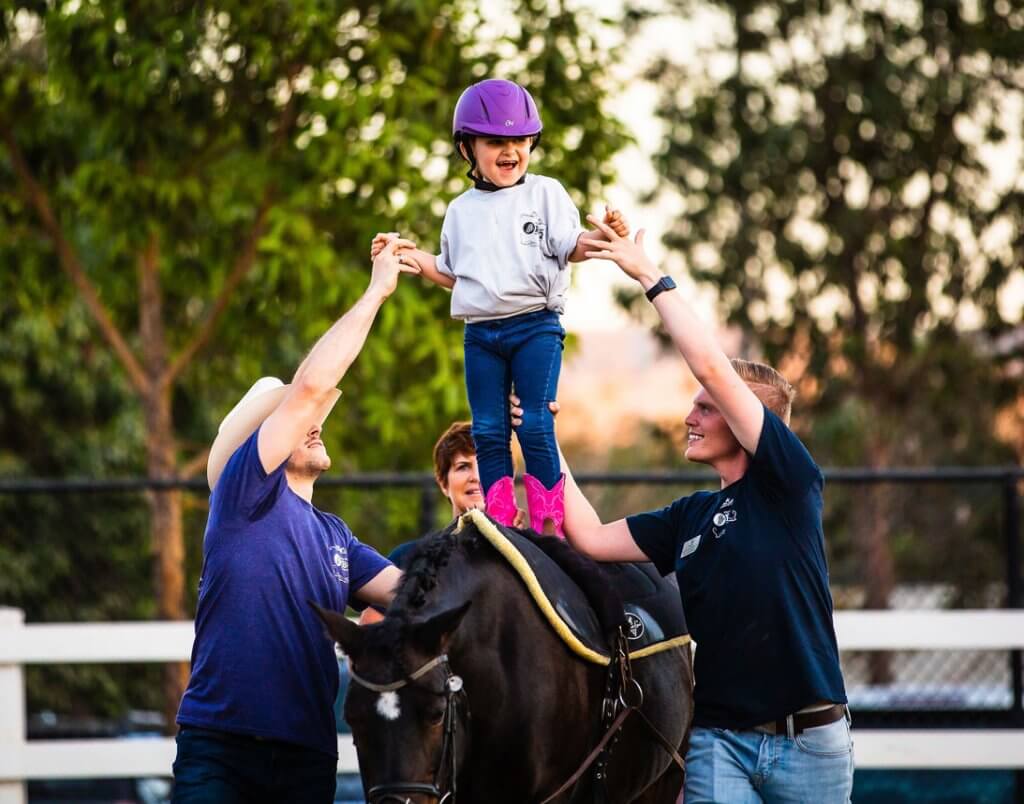
Standing on horseback is no simple feat! Clients at The Shea Center get to experience this thrilling position, with the assistance of trained sidewalkers and therapists, to work on standing balance and lower extremity strength. Clients must also work on transitioning from straddle-sit, to quadruped, to half-kneel, and finally to standing. This process drives learning through complex motor planning. Standing while the horse is moving gives our clients a great confidence boost. Many clients and their parents remark that the clients feel a sense of freedom and independence when on their horse at Shea.